Showing posts with label overshot. Show all posts

Wednesday, October 30, 2013

Weaving, and More Weaving!

Oh, argh!  I haven't posted since August?  (And I honestly had to be sure it wasn't August of LAST year!)  I admit to neglecting the blog for my Facebook and Pinterest pages.  Which probably isn't a good idea.

So!  What's going on?

Mostly weaving, which I'm sure is a huge surprise to everyone.  From most recent to oldest:

The MacAskill Tartan
MacAskill Tartan On Loom
Demonstration season is upon us again!  This year's offering for the Austin Celtic Festival is the MacAskill tartan.  It's being done at the request of the Festival organizer.  Although it's not the oldest tartan - and remember, almost all tartans are less than 200 years old - it's one of the prettiest.  We're using a new thread this time, JaggerSpun's Maine Line 2/20 wool, which is much finer than we've used before.  I'm very pleased with how it's weaving up and am looking forward to getting it off the loom and finishing it.  I think the hand and drape will be very nice.

Rugs and Upholstery
The Rep Rug On Loom
I swore I'd never weave a rug.  I had no interest in rug weaving at all.  When we bought the Glimakra, we bought it from a woman who used it to weave rugs.  Included with the loom were several shuttles specifically for rugs as well as several spools of rug warp.  I almost sold the shuttles, thinking I'd never use them. Fortunately, I didn't.  I recently bought Tom Knisely's master weaving e-book from Interweave.  At first, I couldn't even think of a good reason to buy the e-book.  He specializes in rugs and I had no interest, right?  One of the rugs appealed to me, mostly because of the colors.  I've also been interested since I wove the rep towels from Custom Woven Interiors.  I liked how her rugs (and towels) had an overshot feel to them.  Since I've had so much fun with blocks, I decided to use Tom Knisely's colors and adapt an overshot pattern to rep weave.

I took the Snowballs section of the Wahoo Blossom and Snowballs draft from Marguerite Porter Davison's A Handweaver's Source Book, entered it as a profile draft and then converted it to rep. I admit to making a few mistakes in it, but it's working and I love it!  I warped on enough to get a nice-sized rug and enough upholstery fabric for bench pads for all my looms.

George took this photograph.  He loves the look of the project from below the loom.
You're seeing the underside of the rug wrapped around the beam, the rug border just above the beam and the right side of the upholstery fabric angling down toward the knee beam.

Breaking All The Rules
Breaking All The Rules Christmas Scarf
Schacht Spindle Company just came out with a little goodie for their rigid heddle looms.  The new Variable Dent Heddle (they call it a reed, which it isn't) allows the use of multiple thicknesses of yarn in the same warp. I grabbed one of those at the beginning of the recent Hill Country Yarn Crawl.  I also grabbed a skein of La Boheme in Christmas colors.  La Boheme is an interesting yarn.  It's two strands used as one and one of the strands is mohair.  Now, mohair presents lots of challenges in weaving, when used as a warp thread.  Mohair is very fuzzy and wants to cling to the threads next to it.  There are ways to get around the fuzziness, but if you decide to use the mohair in blocks, as I did, prying the warp apart is something that has to be done in almost every shed.  Slow, but workable.  Then I chose a red sock yarn with an almost velvet look to it.  The red is so rich.  I don't even like reds, normally, but this is a gorgeous sock yarn.  However, sock yarn has lots of stretch and the La Boheme has none.  And I mean NONE.  So tensioning the warp is a challenge.  And I figured that if I'd come this far, I might as well go for broke.  I chose a white, fine laceweight silk/mohair blend in white.  And yes, it has all the mohair fun.  The green and black accent yarns are sock yarns, but they didn't add to the challenges.

But I thought, what the heck, if I'm breaking rules, let's don't stop there!  I left about 18" of warp unwoven in the beginning, then wove the scarf, then used the beginning warp as the weft to weave off the end of the scarf.  All well and good, but how to you put tension on a warp if you've disconnected the beginning of the weaving?  Sew the fabric to the apron rod of the loom about three or four inches from the fell line, tension the warp and go for it!  This gave me a scarf with no beginning or end.  It's not exactly a circle, but it's all connected.  What a fun technique!  I'm very happy with the resulting scarf
The End As The Beginning
Weaving for the Kitchen

I finally did some weaving on the rigid heddle loom to be cut and sewn into items - in this case into two potholders and an oven mitt. My assignment this time was to produce fabric with a mixed warp and not to buy any yarn for it.  All the yarn was hanging around the house, either leftovers from other projects or yarn bought for projects that never happened or something.  There are four yarns in this project, a dark green cotton, a light green cotton, a green/purple variegated chenille and a lavender cotton/wool blend.  The lavender cotton-wool had the most yardage, so I used it for the weft and for a few threads scattered throughout the warp.  All the others were used in the warp.  I'm very pleased with how the items turned out!

Weaving on the Antique Loom
Norse Kitchen Towels on the Sabina Loom

Remember the entry about restoring the old Loomcraft Sabina?  The post is here: The Sabina Weaves Again.  Well, the poor Sabina has been put away since that time as I had no room to unfold her and use her.  At long last, I've started working on the upstairs - converting it into studio space.  We cleared enough room for the Sabina to be brought upstairs and unfolded.  She's in the same room with the Glimakra.  I decided to put a pretty overshot set of towels on her that I've been wanting to weave for some time: Norse Kitchen Towels from Marguerite Porter Davison's A Handweaver's Pattern Book.  I decided to use a 16/2 cotton-linen blend that I will probably NEVER use for warp again.  It's a little delicate and very sticky.  The Sabina has a somewhat anemic shed and warp threads are breaking.  However, that's not the loom's fault and I have another project ready for her whenever I finish these towels.

And that's it for now!  I will TRY to be better about updating my blog!

Tuesday, August 6, 2013

Got Lots of Catching Up To Do!

Guess who has neglected her blog??  I try to keep my Facebook page updated, but my poor blog hasn't had an update in months!  Spring is our busy season, of course, with the most demonstrations, but here we are in the latter part of the summer and no updates have happened.  So here we go!

Well, I'm obviously weaving my little fingers to the bone, although at the moment, not as much on the big looms.  A Schacht Zoom Loom came home with me in early July.  Since then, I've made two bags for it (one for me, one for the shop), a notions bag (for the shop) and two baby blankets (one for the shop).  The little looms are versions of the Weave-It looms from the 1930's.  I have two of the original Weave-It's, as well as a Loomette loom from the 1940's.  I've woven projects on my antique looms, but for some reason set them aside.  Although the antique looms are plenty strong enough to weave on, I do worry about carrying them around.  If I drop the Zoom Loom, no biggie.  So here is a photo of all my hand looms with the yellow / variegated baby blanket I finished a few days ago.
Katie Ann with the Looms!
From left to right are the Loomette (1940's), the wooden Weave-It, the resin Weave-It (both from the 1930's) and the Zoom Loom.  Showing the looms is my mother's favorite doll from the 1940's.

Here's the blue checkerboard blanket I made for the shop.
Blue Checkerboard Blanket

Both blankets have a crocheted edging I got from a 1930's booklet.  Here's a photo of the detail:

Edging Detail

Here's a photo of the first bag I made to carry the Zoom Loom and all its stuff:
The Zoom Loom and its Bag
Making squares on these little looms is a bit like eating potato chips.  You really can't stop with just one!  I've got lots of other ideas for Zoom Loom projects.

Navajo-Style Weaving... from a Cherokee Point of View


The Loom and Me
But before the Zoom Loom craze got me, I was taking some time to do more Navajo-style weaving.  George finished my big Navajo loom.  Of course, by "big" I mean "bigger than the miniature looms."  The loom isn't big enough to weave a full-size rug on, but it's plenty big for me.  The first project.. didn't happen.  I probably made every possible mistake warping it.  I completely removed the warp and started over.  The second warp went on just fine, but it took a few tries to get the design working the way I wanted it to.  The design is a cross between a classic Two Grey Hills design and "Arizona," a song I loved from the 70's.  So that's why I'm using... colors of green and grey instead of more traditional colors.  This is as far as I've gotten:
Arizona Rug on the Loom
So why "From a Cherokee Point of View?"  I'm not Navajo at all, but I do have two Cherokee ancestors. I have a great deal of respect for those two women and I wish I knew more about them.

More Overshot Designs
After finally working through Madelyn van der Hoogt's Block Weaves DVD, I decided to play with some designs from Marguerite Porter Davison's A Handweaver's Source Book.  That book has been following me around for 30-plus years but has been a bit difficult to use. Analyzing the drafts as blocks really helps and makes it easy to convert to more modern weaving drafts.  The first one is a re-work of my favorite Soldier's Return draft.  I made it a little smaller to fit on a scarf and then wove it up in blues and turquoises that reminded me of our trip to Florida and diving in the Keys.  Here's the scarf:

Soldier's Return Scarf

I have lots of other projects waiting in the wings, but I need to finish up things currently on the looms.  I'm weaving another Orange Peel scarf to photograph for the draft available in my Etsy shop.  Once the scarf and Joseph's towels are off the loom, I have lots of new projects getting ready to go on!

And maybe it won't be so long before I do another blog post!

Tuesday, May 1, 2012

Weaving With Cousin Sam, Yet Again

We're back from the General Sam Houston Folk Festival. We have a breather now between the rush of spring demonstrations just past and the Texas Folklife Festival in June. The demonstration loom was finished just weeks before the beginning of the season.  Overall, it's been a resounding sucess.  It's a four-harness, counterbalance loom which can be warped at home, collapsed to fit into the back of our SUV and set up at a demonstration site.  As much as we previously looked like a modern-day covered wagon, we look even more so now!
The Covered Wagon
Here's the loom in the SUV with the tent alongside and the spinning wheel tucked in as well.  Once these things are in, the rest of everything is tucked in as best we can.  The display table which used to go underneath the loom now has to be strapped to the top of the car, but we're a self-contained unit!

Once the loom was finished I warped on a "maiden voyage" project - a overshot scarf.  The warp was a space-dyed sock yarn.  The tabby weft was sewing thread while the pattern weft was sock yarn in tonal purples.  Overall, it looks good.  It was mostly a "iron the bugs out" project.  Here's the loom with the first project on it.
Maiden Voyage
We've had an ongoing problem with the shafts staying horizontal. In the end, I used Joanne Hall's suggestion of elastic loops keeping the upper shaft bars horizontal. It seems to work just fine.

The loom's first outing was to a 3-day workshop with Joanne.  A counterbalance or countermarche loom was required for the Opphämta sample and I had the only one available.  I loved the workshop and I need to take photos of my samples.  The Opphämta is interesting in that it gives a great deal of flexibility in the pattern design, although it is some slower than traditional overshot.

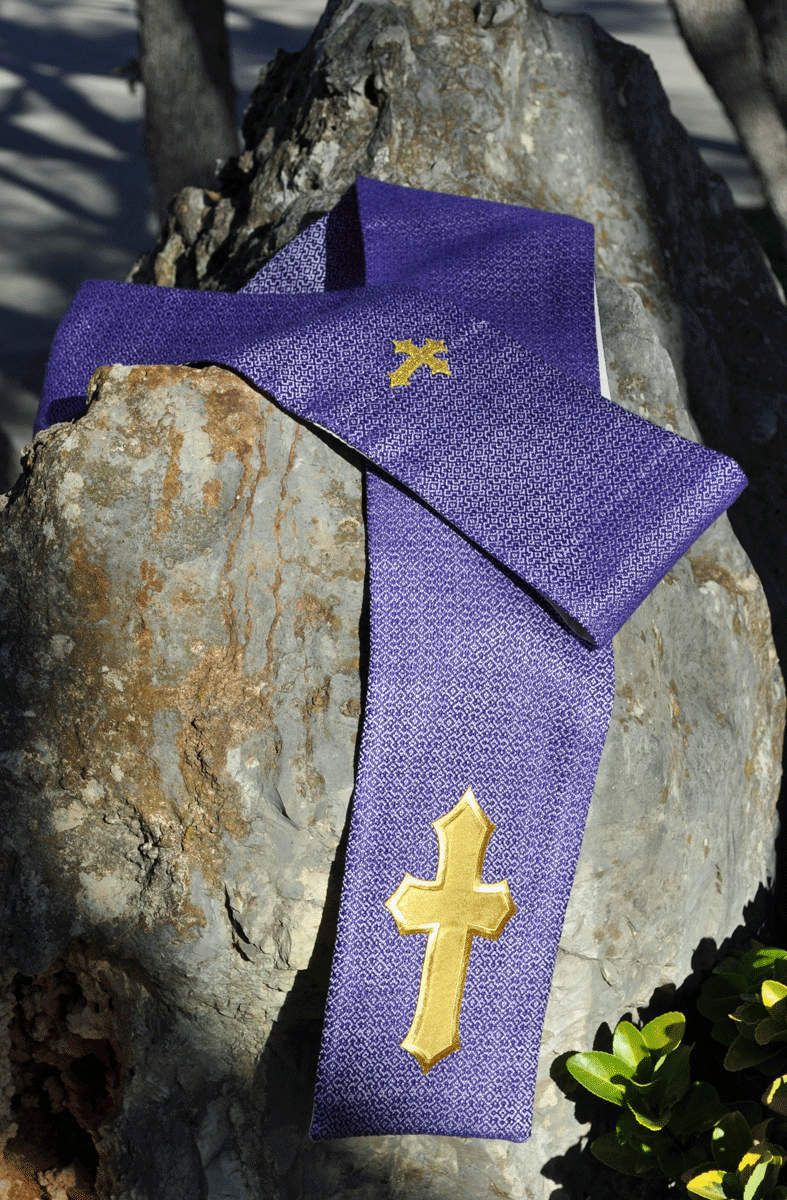
The St.-Francis-Upon-The-Hill Renaissance Faire was the loom's second outing and first demonstration.  Although we were without Cassie this year, I decided to try a "worm to ecclesiastical stole project.  Well, I didn't spin the yarn nor did I dye it.  However, I wove the fabric for the face of the stole at the Faire (mostly).  I chose Gothic Cross from Marguerite Porter Davison's A Handweaver's Pattern Book, and wove it in two shades of purple silk. What a joy silk is to work with!  Gothic Cross is a beautiful pattern but I had trouble keeping track of where I was while demonstrating.  I probably won't try that again!  But I did finish the stole (at five o'clock in the morning!) in time for Elizabethean Mass the following morning!
The Stole
Next up was a one-day festival at Camp CAMP, a camp in the Hill Country set up specifically for children with developmental difficulties, who can't attend a regular camp.  What wonderful work they're doing!  They wanted a mini-Folklife Festival, so we found ourselves in company with a blacksmith and a flintknapper.  I'd never seen flint shaped into spearheads or arrowheads before.  It's fascinating!  And to me, a blacksmith is a magician.

I chose to do a traditional overshot pattern in very untraditional colors for the Fest.  It turned out beautifully!  I don't have any photos of the piece on the loom, but the piece is still in my possession and I'll get photos of it soon.

Our next outing was the San Antonio Highland Games.  Sadly, the piece we chose to weave didn't make it through the transportation process.  Something happened, either in my setting the loom up or during moves, that caused the tension to go completely crazy.  Once I had the tension corrected, I had breakage problems in the warp.  I finally had to give up on the piece.  I'll weave it again this summer as it was a beautiful sash in the MacLean Hunting tartan.  The sash was intended for Cassie, so it hurt doubly bad to lose it.

And now for Cousin Sam's Festival!  The Festival was only two days this year instead of three.  Friday was still School Day, but with maybe 2/3 the number of children we saw last year.  The loom covered itself with glory.  I tried Barleycorn, a structure I've never tried before.  I was scared at first because Barleycorn is based on huck lace which is an unbalanced weave. Counterbalance looms want to move two shafts at a time.  Huck lace puts three shafts against one.  However, huck has been woven for centuries and must have been woven on counterbalance looms.  The loom, of course, did just fine.
Barea Linen (Barleycorn) Towels On The Loom
I warped four towels on the loom, intending to weave off two during the Sam Houston festival and the last two during Folklife. However, I was well into the second towel by the end of the first day and into the third by the end of the second day.  I'll weave these off and choose another project for Folklife.  The first two towels used a pale willow green as the pattern weft.  I was getting a little tired of it by the end of the second towel, so the last two are being done with a periwinkle shade - kind of a purple-blue.  They're turning out very well.

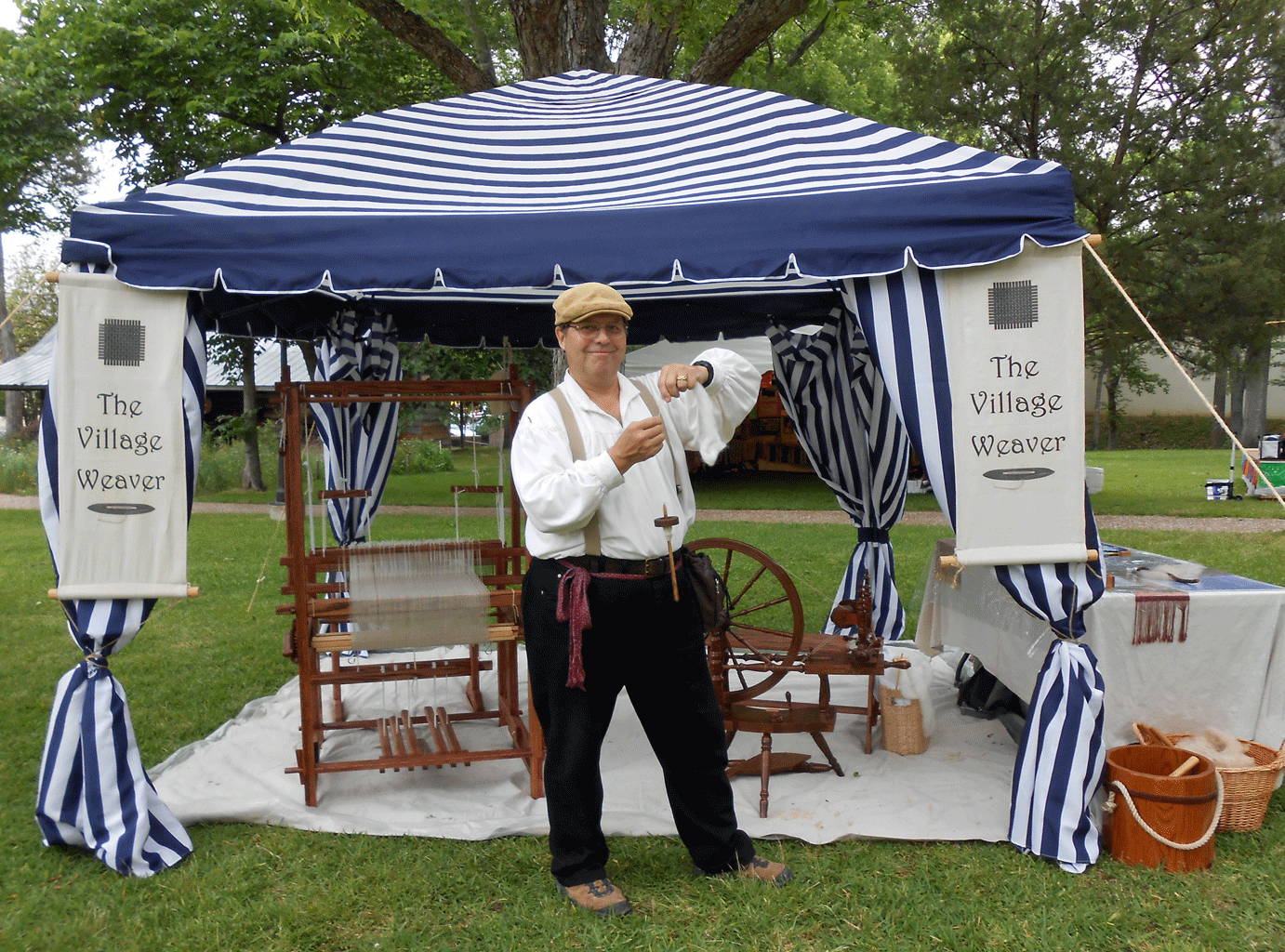
Here I am in my prairie regalia weaving away at the Festival.
And one last shot of the entire booth with George demonstrating drop spinning.

And it's not like I'm doing no weaving in between festivals.  I have another Atwater-Bronson lace shawl on the Glimakra.  George upgraded it to a 10-shaft countermarche loom and this is its maiden voyage.  I've designed four overshot scarves, one of which is one the loom now.

But that's all for now.  More later!

Wednesday, June 15, 2011

Weaving in the Heat

Ah, the Texas Folklife Festival!  Three days outdoors, demonstrating in 100-degree heat.  Yeah.  My idea of a lot of fun!  Actually, in many ways it was fun.  We were sweaty and exhausted every night when we got home.  But the response to our demonstrations was enthusiastic.  We could hardly leave the booth.  When one group would leave, another would arrive.
Spinning on the Polonaise
This is the second outing for the new Kromski Polonaise spinning wheel.  She is a joy to spin on.  She looks antique, but she's a beautiful modern wheel.  Since I'm the best wheel spinner of the three of us, I would sit and spin.  The wheel is so eyecatching - as soon as I set her in motion, the crowds would gather around.  After three days, I'd spun an entire bobbin of yarn - and Kromski bobbins are larger than average!!  I'll ply the yarn and dye it this week.  It may be knitted into socks or it may find its way into a woven piece.   You never know!


We also received more requests for photos than we've ever had before.  People seemed drawn to the prairie dresses worn by both Cassandra and myself.  Cassandra looks so natural in her grey dress.  I just look really, really OLD in mine!!  But they are comfortable - or as comfortable as anything can be in this heat!  I insisted that Cassandra put on her bonnet whenever leaving the tent, as did I.  Neither of us burned.  Hey!  Our ancestresses must have known what they were doing!

George got a proposal of marriage!  A charming Czech lady came to the booth to watch us spin.  She had a miniature spinning wheel - most likely a woodturning apprentice's "final exam" piece.  It had been "fixed" by somebody who "knew all about spinning wheels."  Needless to say, the poor thing couldn't spin.  Honestly, it probably never did well, nor was it intended to.  However, George went with her to look at the wheel.  He was able to fix it for her and get it going again.  As if that weren't enough, he noted the red dye on the decorated eggs the ladies had on display.  They told him the dyestuff was cochineal, but they didn't know anything about it.  He was able to fill them in on the story of cochineal.  They were delighted!

Czech Decorated Egg
So they gave him one of the beautiful decorated eggshells, an information sheet about the eggs, a hug, and a proposal of marriage!  Let's see...  He's up to how many wives now??

I've known about the Polish version of the decorated eggs - Pysanki, I think it's called.  I didn't know about the Czech eggs - Kraslice.  Instead of drawing the design on the bare egg with wax, dyeing the egg so the shell takes the color everywhere except where the wax is, and then melting the wax off, Czech eggs are dyed a single color and then the design is scratched off to reveal the egg underneath.  Cochineal is commonly used to get the strong, bright red color.

Fabric View of the Draft
But the excitement for me was the weaving of my very first design!  I've been wanting forever to do the overshot patterns in Marguerite Porter Davison's A Handweaver's Source Book.  But for years they've made no sense to me.  I decided that I would finally come to grips with them.  I chose Soldier's Return (page 40) for my first foray into understanding these drafts.  It really wasn't all that hard.  However, the floats were longer than I wanted.  So I started to tweak.  And tweak.  And really tweak.  And suddenly, I had a fabric that didn't look like the original, exactly, but it looked beautiful!  So I thought, why not?

Why not?  Well, it has to be crazy to use an untested draft at a demonstration with thousands of people watching.  Okay, 99.9% of the thousands of people don't know anything about weaving, so you can get away with some things.  However, your 19-year-old beginning weaver daughter needs to be able to weave this pattern and she's never woven overshot before.  And so???

And so I did it.  And it's beautiful!  People were fascinated with it.  Cassie was able to weave it with no problems after the first repeat or so.

Cassie at the loom
When I took the runner off the loom, I was suprised to see that it was almost two feet longer than I thought it would be.  Hmm...  I'm still not sure how I did that.  It's really too long, but it's so pretty.  I think I'll try weaving it off in a finer thread.  I have a large cone of natural 20/2 perle cotton and a large cone of 16/2 perle cotton coming.  (Excitement!!)

The Finished Runner
Overshot In Color

Overshot In Color Runner
I finished this overshot runner several weeks ago, but didn't get photographs until after the Folklife Festival.  This is a draft from the November / December 2010 issue of Handwoven magazine.  It is a beautiful runner!  Three closely analagous colors are used for the warp and tabby weft.  The warp alternates the mid and light tones of the color while the warp is the darker tone.  This gives the background fabric a depth that it usually doesn't have.  I liked this project so much that I ordered silk to do another "colorwork" overshot piece.  This will be interesting!

And in the meantime?  Well, I'm making up another prairie dress and pinafore for myself and another shirt for George.  When we do these multiday demonstrations, we need multiple outfits.  And it's fun to have costume pieces to mix and match. I found an antique end-feed shuttle in an antique store this week.  The wood is dry and the metal rusted, but I think it can be brought back into service and that will be fun!  And on to weaving off the colorwork pillows I started before the Festival.

Thursday, April 14, 2011

Time to Weave

With George having started his new job on Monday, we're adjusting to this new phase of our lives. He wasn't very enthusiastic about the new place, but how could he be? Our last jobs were as perfect as any job could possibly be. However, I'm delighted to see his enthusiasm building. He's learning so much, and sees the opportunity to learn much, much more. This is a very good thing!

And me?  Well, I'm learning lots, too, about weaving. I'm taking this time to learn and practice things I've wanted to learn forever. Now that I seem to be over the worst of the warping issues, dressing the loom is nowhere near the daunting task it has been in the past. It's kept me from weaving for years.

Weaving to Sell
So I decided to see if I could actually sell my work. Many people have encouraged me, including a woman at the St. Francis In The Wood Fair.  I think she's probably one of my guardian angels. I'm convinced my angels show up in human or animal form from time to time to take care of me and push me in directions I need to go.  They have some typical forms I'm coming to recognize, too.

After being inspired by a piece on Ravelry's Warped Weavers group, I decided to use some variegated Tencel I've had laying around forever. I used the variegated in the warp and black Tencel in the weft. I somewhat fearfully chose a twill pattern in Marguerite Porter Davison's A Handweaver's Pattern Book. I say fearfully because the drafts in the book are in the old style and I wasn't sure I could read them correctly. But it proved much easier than I had feared.  There were a couple of  false starts. I forgot the prime rule of design.  If you have a complicated yarn, and most variegated yarns are, you need a simple structure. Of course, I tried a complicated structure. And immediately unwove it and used a simpler tie-up and treadling. I promptly broke a warp thread - Tencel takes less abrasion than bamboo, I think.  But I patched the thread and had no further trouble with it.

The two scarves I warped on wove off quickly enough, especially considering I was also weaving the Peacock Shawl on the 8-harness loom. They looked good, even straight off the loom.  But wet-finishing provided the miracle it usually does.  And without further ado...

Twill Scarves
Here is one of the scarves!  With an amazing amount of fear and trepidation, I opened an Etsy shop where I listed them for sale.  We'll see what happens!  I need to spiff up my shop, but at least it's there.

I'm pleased with the interplay of the color against black.  If I had it to do over again, and had an unlimited amount of Tencel in the house, I think I'd choose a navy blue for the weft.  The black is a little harsh.  Here's the detail of the scarf.
Twill Scarf Detail

Overshot is Hot... But Slow
The Overshot Runner on the Loom
I'm gravitating to finer weaves and more traditional structures. I've wanted to try overshot for years.  I've been collecting overshot books forever, it seems.  But I've never actually tackled a project. Warped Weaver's winter Weave-Along this year was overshot.  Looking through the postings, I decided to squeak a last project in on that WAL. I chose a table runner project in one of Interweave's e-books - the same project that many others in the WAL chose. For a first project, I'm glad I did. I used a natural colored cotton in the warp and tabby weft and an indigo blue wool for the pattern weft. It looks almost black and white in the photos, but I was going for the traditional natural / indigo look.


Threading the loom required attention.  It's amazing how complex something can be in only four harnesses. But I used the small-group theory of threading - thread a small number of heddles, double check them, tie them off and forget them!  Thankfully, there were no mistakes. When I started weaving the tabby header I was almost dismayed to see how open the weave was.  But fortunately, I had the benefit of everyone else's experience telling me that the tabby needs to be open to accomodate the pattern weft. I planned the pattern weft in a single strand of the blue wool.  But when I sampled it, it seemed kind of thin.  I opted to double the wool... and promptly realized I didn't have enough.  I think that problem will get taken care of, though.

Overshot Detail
So beautiful... And so much what most of us think of as traditional American.  Overshot didn't originate here - like many things it was brought here by the colonists, but it was raised to a folk art here.  So many patterns were developed here and have names reflecting American history - much like quilt patterns and names.  Next up will probably be placemats in Lee's Surrender at Appomattox... if I can get my parents to stop cringing at the name!

The Peacock Shawl is Finished
And it's as beautiful as I thought it would be. I have several more color combinations in mind to do it next time.  I want to try the peacock color again but using an emerald green for the weft instead of moss green. I think the resulting color will be closer to true peacock.  And I want to do it in two tones of white - I think it would be beautiful for a bride.  And I'm going to try the unthinkable - running a glimmer thread along with some of the warp threads. I'll probably get tensioning nightmares, but that's what the weighted S-hooks are for.  And I have two shades of pink in SoySilk that would probably be gorgeous!  So many projects, so little time!
The Shawl